

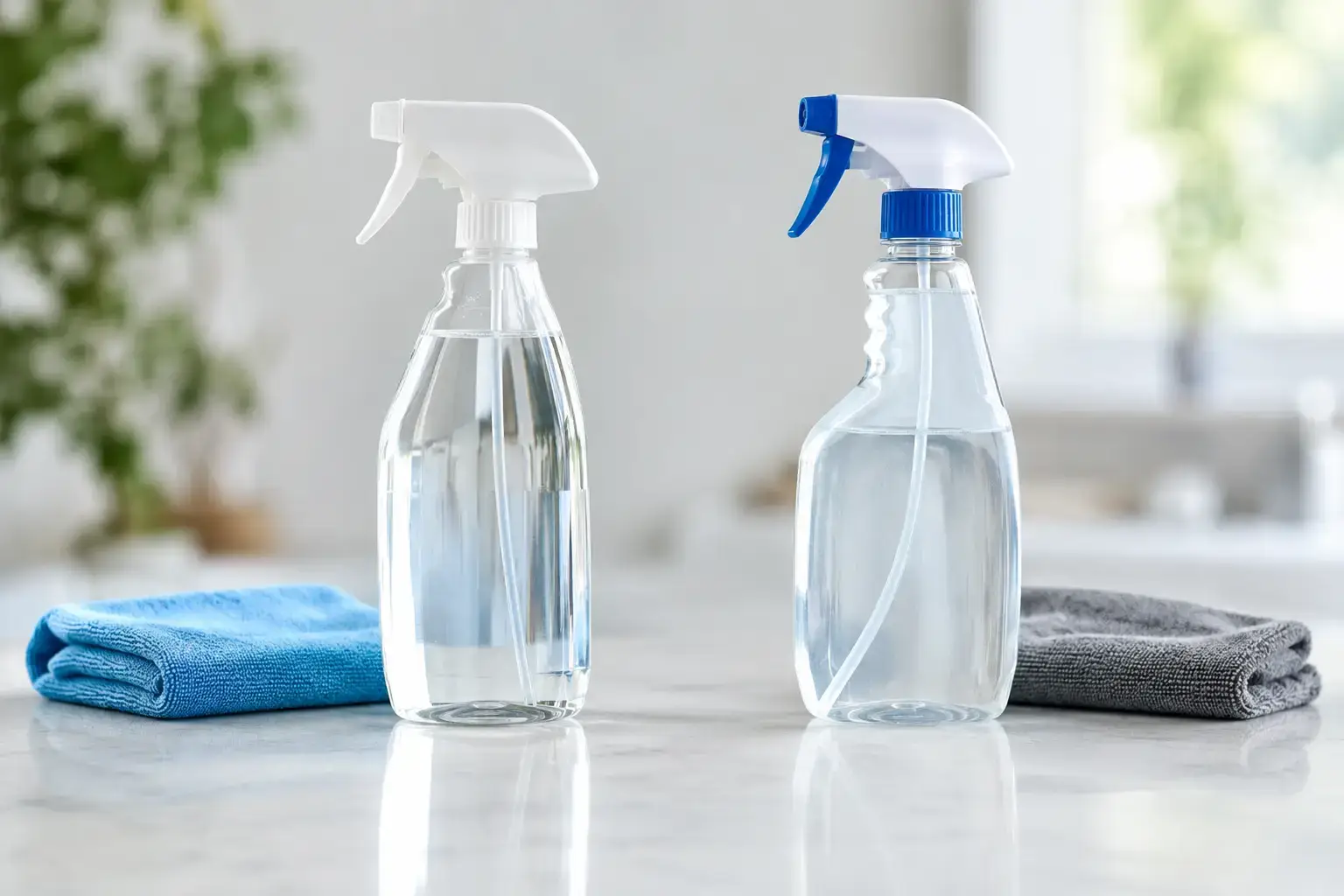
A spilled drink at a restaurant table, a patient waiting room between appointments, a locker room with persistent odor, and a busy family kitchen all create the same practical question: what should the cleaning team reach for next? HOCl versus alcohol is not simply a chemistry debate. It is a decision about worker comfort, surface longevity, supply costs, odor control, and whether a sanitation routine can actually be repeated all day without creating new problems.
Alcohol has earned its place in many settings, particularly for small, fast-drying applications. But it is not automatically the best answer for every surface, every facility, or every cleaning workflow. Hypochlorous acid, commonly called HOCl, offers a different approach: a water-based solution that can be produced on site, applied broadly where appropriate, and integrated into everyday cleaning and deodorizing routines.
HOCl Versus Alcohol Starts With How They Work
Alcohol-based products typically rely on ethanol or isopropyl alcohol, often at a high concentration. They work best when the right concentration is maintained and the surface stays wet for the product’s stated contact time. Their fast evaporation can be useful for certain small applications, but it also means crews need to pay attention to coverage. A product that disappears before it has been applied thoroughly does not make a stronger cleaning process.
HOCl is a form of free available chlorine that can be made from water, salt, and a small amount of acid. The body itself produces hypochlorous acid as part of its natural immune response. In a properly produced, pH-neutral solution, HOCl is designed to support cleaning, odor control, and sanitation with a much less harsh day-to-day profile than many conventional chemical options.
That distinction matters operationally. Alcohol is often chosen because it is familiar and readily available in bottles or wipes. HOCl is increasingly chosen because it can make routine cleaning more practical across larger areas, while reducing dependence on harsh, heavily fragranced, or flammable products.
Where Alcohol Makes Sense – and Where It Creates Friction
Alcohol can be a sensible option for limited, targeted tasks. It dries quickly, leaves little residue, and is convenient when a small item needs attention and the product directions fit the intended use. For personal electronics or other sensitive materials, however, compatibility should always be checked with the device manufacturer. Alcohol can affect coatings, plastics, adhesives, inks, and finishes over time.
For larger cleaning programs, alcohol’s weaknesses become more obvious. High-alcohol formulas are flammable, which adds storage and handling considerations. Strong fumes can be unpleasant in enclosed spaces or when employees are cleaning repeatedly throughout a shift. And because alcohol evaporates so quickly, applying it across broad surfaces can become expensive, labor-intensive, and inconsistent.
Alcohol also does not solve every odor problem. It may temporarily mask a smell if fragrance is included, but odor control is not the same as covering an odor with scent. Facilities dealing with restroom odors, food-service residue, gym equipment, pet areas, waste zones, or agricultural environments need a solution built for the source of the problem, not just a cleaner-smelling room.
Why HOCl Fits Everyday Cleaning Programs
HOCl gives homes and facilities a practical middle ground: powerful sanitation support without making harsh chemistry the default. Because it is water-based and can be produced at a near-neutral pH, it is well suited to frequent use in many everyday environments when used according to product directions and surface-compatibility guidance.
For a homeowner, that may mean one simple solution for counters, bathrooms, high-touch areas, pet spaces, and odor-prone zones. For a facility manager, it can mean a more consistent product platform across restrooms, break rooms, lobbies, dining areas, guest rooms, classrooms, and common surfaces. Fewer product types can simplify staff training, purchasing, labeling, and storage.
The biggest advantage is often not a single spray bottle. It is the workflow. With on-site generation, teams can produce fresh HOCl as needed rather than continually ordering, receiving, storing, and replacing cases of conventional cleaners. That is especially valuable when supply chains tighten, freight costs rise, or a facility cannot afford to run short on daily sanitation materials.
Microbe Ninja’s NinjaGen systems are built around this model. They convert water, salt, and a small amount of organic vinegar into pH-neutral HOCl solutions at 200, 500, and 1,000 ppm. The right concentration depends on the task, the application method, the operating environment, and the procedures a business has established. The important point is control: operators can make the solution they need, where they need it, without treating every cleaning challenge as a reason to buy another harsh chemical.
Surface Care Is a Business Decision
Cleaning products do more than affect cleanliness. They affect the assets a business has already paid for. Repeated exposure to aggressive chemicals can dull finishes, damage fabrics, degrade seals, stress plastics, or leave residues that attract more soil. Alcohol can be particularly challenging on certain coated screens, acrylics, painted surfaces, and bonded materials.
HOCl is not a free pass to ignore surface guidance. Any solution can cause issues if it is used at the wrong concentration, left on an unsuitable material, or applied without following manufacturer instructions. Still, a pH-neutral HOCl program may be easier to build around sensitive, high-use environments than a routine based on high-alcohol products.
This is where trialing matters. Test a small inconspicuous area, document the process, and train staff on proper application. A cleaning program works when employees can execute it consistently during the busiest part of the day, not only when a supervisor is watching.
The Cost Comparison Goes Beyond the Bottle
Comparing HOCl and alcohol by bottle price alone misses the larger operating cost. Alcohol-based products often involve recurring purchases, packaging waste, storage space, shipping exposure, and variable availability. Wipes add another layer of recurring material cost and disposal volume.
On-site HOCl generation shifts the model. The inputs are simple, and each batch can cost pennies compared with repeatedly purchasing ready-to-use conventional products. For high-volume users, that difference can become meaningful over months of cleaning shifts, not just during a single order cycle.
There is also a labor component. If employees need separate products for deodorizing, broad-surface cleaning, touchpoint routines, and odor events, they spend time selecting, carrying, changing, and restocking products. A thoughtfully designed HOCl program can reduce that complexity. It will not replace the need for removing visible soil, following task-specific procedures, or using mechanical cleaning where needed. It can, however, make the routine easier to standardize.
Which Option Is Right for Your Facility?
The honest answer is that it depends on the job. Alcohol may remain useful for narrow applications where rapid drying is the priority and material compatibility has been confirmed. It can be a familiar tool in a broader program.
HOCl is often the stronger long-term choice when the goal is frequent cleaning across many surfaces, practical odor control, lower ongoing chemical costs, and less reliance on flammable or harsh products. It is especially compelling for schools, hospitality operations, food-service spaces, medical offices, retail stores, gyms, offices, farms, greenhouses, and households that want a safer everyday approach.
Before changing products, evaluate the surfaces you clean, the size of your operation, current supply costs, storage constraints, employee exposure concerns, and the type of odors or sanitation challenges you face. Then choose equipment and application methods that match the workload. A compact generator can serve a home or small business, while larger systems can support high-volume operations and service-based businesses.
The better cleaning choice is the one your team can make consistently, affordably, and confidently. For many operations, HOCl turns sanitation from another recurring supply problem into an on-demand capability.
Comments are closed