

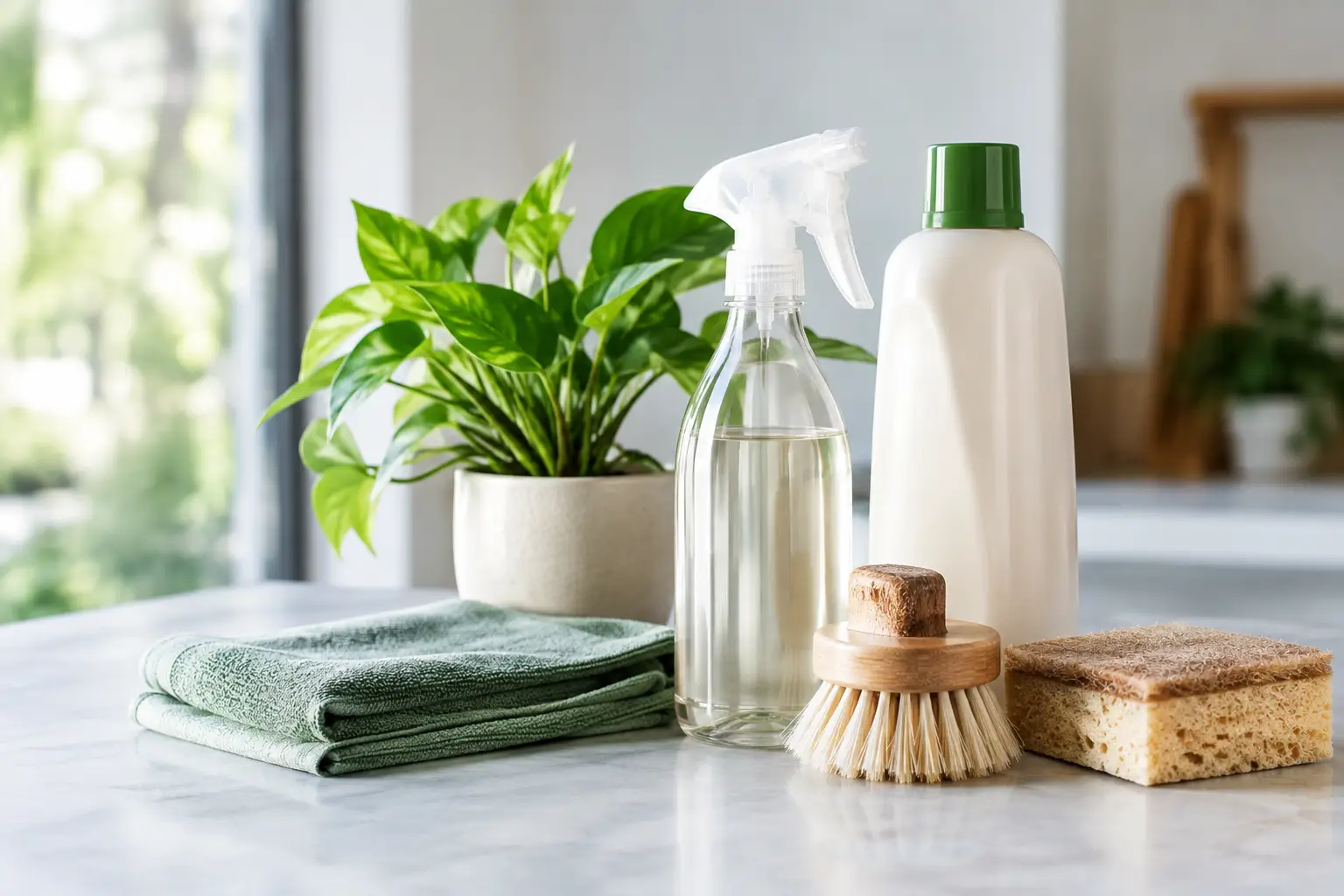
A supply closet full of half-used bottles is expensive, hard to manage, and rarely as safe as it looks. Sustainable cleaning products offer a better standard: strong cleaning and odor control with less plastic, fewer harsh ingredients, and less dependence on recurring shipments.
For a homeowner, that can mean fewer products under the sink. For a facility manager, it can mean simpler staff training, more reliable inventory, and lower cost per usable gallon. The goal is not to buy a green label. It is to build a cleaning system that performs reliably without creating unnecessary waste or exposure concerns.
What Makes Cleaning Products Sustainable?
Sustainability is more than a plant-based ingredient or a bottle with a recycling symbol. A product should be evaluated across its full working life: what it contains, how it is packaged, how far it travels, how much is used per task, and what remains after cleaning is done.
A concentrated product may reduce packaging, for example, but only if it is diluted correctly and does not require several additional specialty products to finish the job. Refillable containers can reduce plastic, but the refill system must be practical enough that people actually use it. The strongest option is often the one that reduces complexity while delivering consistent sanitation results.
For homes and businesses, sustainable choices generally share several qualities. They limit harsh chemical exposure, work efficiently on common cleaning tasks, reduce single-use packaging, and avoid creating a constant cycle of purchasing, storing, and disposing of bottles. They should also fit the real surfaces and soil loads in the space. A hotel laundry room, a restaurant kitchen, and a family bathroom do not have identical needs.
Why Harsh Chemicals Create Hidden Costs
Conventional cleaning programs can look inexpensive at the point of purchase, then become costly in daily operation. Separate products for glass, floors, restrooms, odor control, kitchen surfaces, and general cleaning create purchasing complexity. Each product needs storage space, labeling, training, and replacement inventory.
Harsh formulas can also bring practical trade-offs. Strong fragrances may mask odors rather than address them. Aggressive chemicals can be unpleasant to use in occupied spaces and may not be suitable for every surface. Mixing incompatible products is a serious safety risk, especially in busy facilities where multiple team members handle cleaning.
Then there is the waste stream. Ready-to-use bottles are mostly water shipped in plastic containers, often over long distances. When a facility goes through cases of product every month, the environmental impact includes the packaging, freight, storage, and disposal – not just the ingredients on the label.
A sustainable system challenges that model. Instead of managing a crowded chemical closet, it asks whether one safer, versatile solution can cover more routine work with less waste.
On-Site HOCl Changes the Equation
Hypochlorous acid, or HOCl, is a practical option for organizations and households that want cleaning, deodorizing, and sanitation support without relying on harsh conventional chemicals. HOCl is produced from simple inputs: water, salt, and, in certain systems, a small amount of organic vinegar to help create a pH-neutral solution.
The key advantage is on-site production. Rather than repeatedly ordering ready-to-use products, users can make fresh solution where it will be used. That reduces shipping weight, packaging consumption, supply interruptions, and the need to keep large quantities of chemical products on hand.
Output strength matters because different tasks call for different solutions. Systems that produce 200, 500, and 1,000 ppm HOCl give users a way to match solution strength to their intended cleaning, deodorizing, and sanitation routine. The right approach depends on the surface, the environment, the amount of organic soil present, and the operating procedures of the home or facility.
Microbe Ninja NinjaGen systems are built around this practical model, from compact units for homes and small businesses to high-volume equipment for commercial operations. The result is a supply that can be produced for pennies per batch instead of purchased bottle by bottle.
Less Shipping, Less Plastic, Less Guesswork
On-site generation does not eliminate the need for responsible handling. Solution quality, storage conditions, clean applicators, and routine equipment care all matter. Yet it can substantially simplify procurement. A facility may replace repeated deliveries of bulky ready-to-use products with a dependable process based on basic inputs and reusable dispensing equipment.
That simplification matters when supply chains are strained or when a business operates across multiple locations. It also matters for service businesses. An entrepreneur providing cleaning and deodorizing services can build a differentiated offering around on-demand solution production rather than carrying an ever-changing inventory of conventional chemicals.
How to Choose Sustainable Cleaning Products That Actually Perform
Start with the job, not the marketing language. Identify the surfaces being cleaned, the type of soil or odor involved, how often the area is used, and whether children, patients, guests, food-service workers, or animals are present. A sustainable product is only a good fit when it works safely and consistently in its actual environment.
Next, look at the total system. Does the product require disposable wipes, multiple companion chemicals, special storage, or excessive personal protective equipment for normal use? Does it arrive in single-use packaging every week? Can staff understand when and how to use it without a complicated color-coded maze of bottles?
For commercial buyers, calculate cost per application or cost per gallon in use, not merely the price of one container. Include freight, storage, dispensers, employee time, waste hauling, and stockouts. A lower-priced bottle can become the more expensive choice when it creates daily friction across the operation.
Finally, make sure product claims and use instructions match your needs. Follow all manufacturer directions, use appropriate contact times where provided, and verify compatibility on sensitive materials before broad application. Sustainable cleaning should never mean casual cleaning. It means using fewer unnecessary resources while maintaining a disciplined standard.
A Smarter Routine for Homes and Facilities
The most sustainable routine is usually the one people can repeat without shortcuts. Keep frequently used applicators filled and clearly identified. Clean visible soil before applying a sanitation solution, because buildup can interfere with results. Use reusable microfiber tools when they can be properly laundered and maintained, rather than treating disposable products as the default.
In a home, a versatile HOCl solution can help simplify daily routines in kitchens, bathrooms, entryways, pet areas, and high-touch surfaces. In a school, office, medical setting, restaurant, hotel, or retail location, on-site production can support a more consistent sanitation program while reducing the number of products staff must learn and store.
Agricultural operations have another layer to consider. Farms, greenhouses, and growing facilities need cleaning and odor-control practices that respect people, equipment, and the demands of a working environment. A generator-based approach can provide a dependable on-site resource without making the operation dependent on frequent specialty-chemical deliveries.
Sustainability Needs Measurement, Not Assumptions
Switching products is easy. Improving a cleaning program takes measurement. Track how many containers are purchased and discarded each month. Compare the cost of shipping and storage before and after a change. Ask cleaning teams whether the process is easier to follow and whether they can access solution when they need it.
For facilities, it is also useful to watch inventory outages, staff feedback, odor complaints, and time spent changing products between tasks. These details reveal whether a new system is actually reducing waste and workload, or simply moving the burden elsewhere.
There are trade-offs. A generator requires an upfront investment, basic operator training, and attention to solution preparation and storage. For a household with very occasional cleaning needs, a simple refillable product may be enough. For a busy business, multi-unit property, or cleaning service, the operational savings and supply independence of on-site generation can be far more compelling.
Sustainable Cleaning Is an Operating Decision
The best sustainable cleaning products do more than sound responsible. They reduce the number of bottles, processes, and supply-chain headaches between a dirty surface and a clean, comfortable space. They help protect the people doing the work while giving managers a clearer handle on cost and inventory.
Choose solutions that make the right routine easier to maintain. When cleaning can be produced on demand, applied with purpose, and managed with less waste, sustainability stops being a claim on a label and becomes part of how the space runs every day.
Comments are closed