

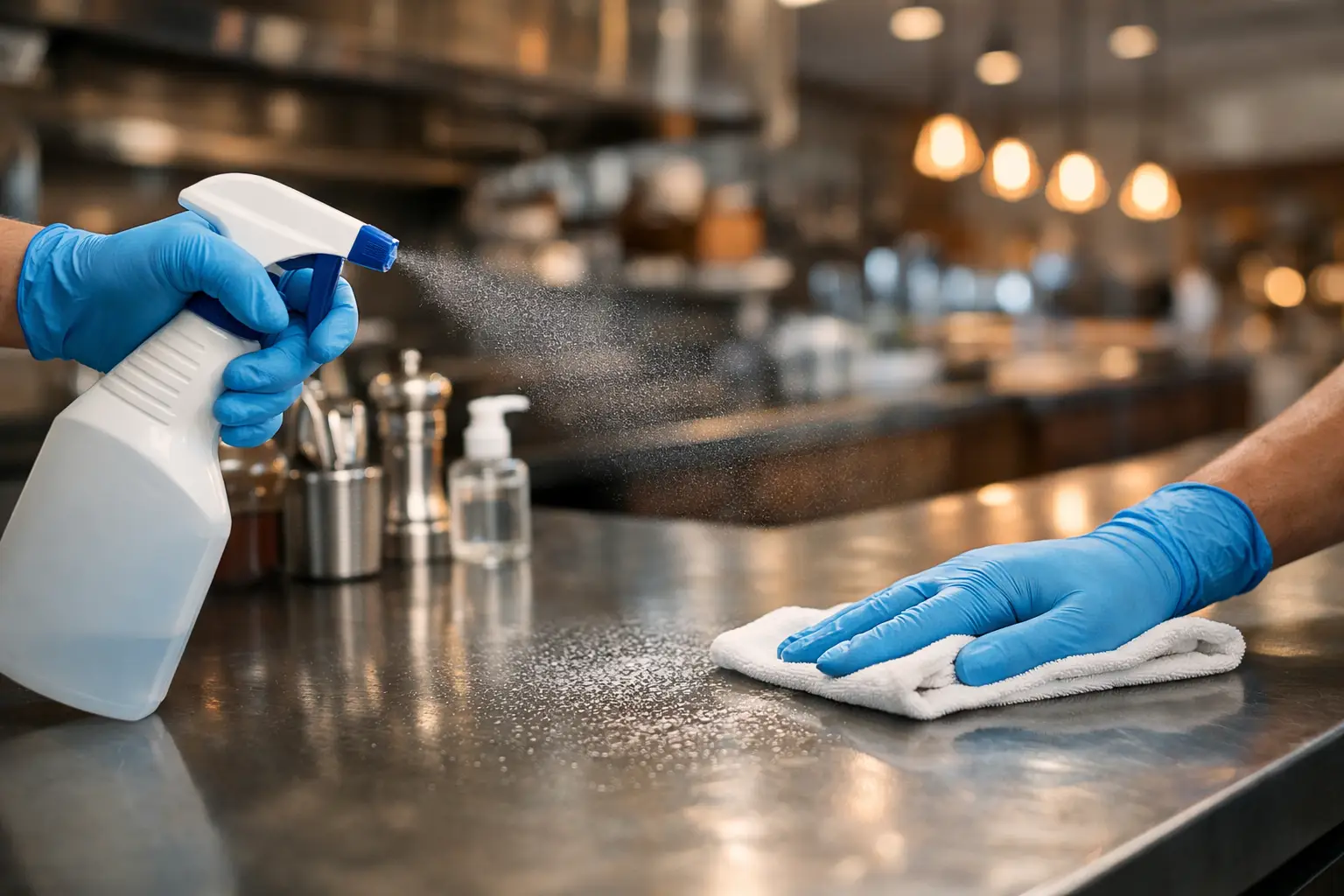
A restaurant food contact surface sanitizer is not a substitute for cleaning. It is the final, controlled step that helps a kitchen keep prep tables, cutting boards, utensils, slicers, pans, and beverage-contact equipment ready for the next task. When that step is rushed, mixed incorrectly, or applied to a dirty surface, a sanitation program can look complete on paper while failing where it counts: at the point where food is handled.
For restaurant operators, the goal is straightforward. Build a process that staff can repeat during a busy shift, verify without guesswork, and maintain without filling storage rooms with harsh, expensive chemical products. The best program balances food safety requirements with speed, worker comfort, surface compatibility, and dependable supply.
What Counts as a Food-Contact Surface?
A food-contact surface is any surface that normally touches food or that can drain, drip, or splash into food. That includes obvious items such as prep tables, knives, cutting boards, mixing bowls, tongs, deli slicers, ice scoops, and steam-table pans. It can also include the interior components of beverage equipment, food processors, and storage containers.
This distinction matters because a floor cleaner, restroom product, or general-purpose degreaser is not automatically suitable for a prep station. Food-contact surfaces require products and procedures designed for that use. Always follow the product label, applicable local health department rules, and the equipment manufacturer’s instructions.
The process also changes by task. A cutting board used for raw poultry needs cleaning and sanitation before it returns to produce prep. A wiped counter may need the same treatment after handling eggs, raw seafood, or a spill from a ready-to-eat item. High-volume kitchens cannot rely on a once-per-shift approach when the risk changes throughout the day.
Restaurant Food Contact Surface Sanitizer: The Right Sequence
Sanitizing works best as part of a sequence, not as a quick spray over visible soil. Food residue, grease, proteins, and mineral buildup can prevent a sanitizer from contacting the surface evenly. That is why the practical question is not simply, “What product do we use?” It is, “Can our team execute the whole process correctly every time?”
1. Remove debris and wash first
Scrape, rinse, or wipe away food debris. Then wash the surface with an appropriate cleaner or detergent and clean water as required by the procedure. This is the step that removes grease and soil. A sanitizer is not designed to carry the burden of a dirty prep table.
2. Rinse when the cleaning product requires it
Residue from some cleaning products can interfere with the sanitation step or leave an unwanted film. Follow the cleaning product directions and your established operating procedure. Skipping a rinse because the kitchen is busy can create inconsistent results.
3. Apply the sanitizer at the labeled concentration
Use only a product that is approved and labeled for food-contact surface sanitizing, and mix or generate it according to its directions. Concentration is not a place for estimation. Too little may not perform as intended; too much can create unnecessary residue, odor, cost, or a rinse requirement.
For operations using a generated hypochlorous acid solution, concentration control is a key advantage only when it is measured and managed. A system should produce the intended ppm range consistently, and the operation should verify the solution with the appropriate test method. A number displayed on equipment is useful, but a verification routine makes the program accountable.
4. Keep the surface wet for the required contact time
A sanitizer needs enough time on the surface to work. If it dries immediately because it was misted too lightly, wiped away at once, or applied to a hot surface, the process may not meet the product directions. Train staff to fully wet the surface without oversaturating food, equipment openings, or electrical components.
5. Air dry unless directions say otherwise
Freshly sanitized utensils, boards, and prep surfaces should generally air dry. Drying with a towel can reintroduce contamination, especially when the towel has already been used around the kitchen. If a product label requires a potable-water rinse for a particular use, that instruction takes priority.
Why Dilution, PPM, and Testing Matter
Many sanitation failures are concentration failures. Manual mixing can vary from employee to employee, especially when measuring is rushed, bottles are refilled without a procedure, or the water source changes. A solution that looks and smells normal may still be outside its usable concentration.
Test strips or another appropriate verification method give managers a fast answer. They also make training less subjective. Rather than telling an employee to use “a splash” of product or fill a sink “about halfway,” the team has a defined range, a written procedure, and a check before service begins.
Hypochlorous acid, often called HOCl, is compelling for restaurants because it can support a lower-harshness sanitation approach when produced and used correctly. On-site generation can reduce dependence on delivered chemical inventory by using water, salt, and a small amount of organic vinegar to create a pH-neutral HOCl solution. But on-site production does not remove the need for controls. The restaurant still needs to confirm the solution concentration, storage conditions, intended use, and compliance with the applicable label and local requirements.
For a single-site cafe, a compact generator may make sense for filling labeled spray bottles and sanitation stations. For a commissary, hotel kitchen, grocery prep department, or multi-station restaurant, a larger system may better match daily volume. The right choice depends on usage, refill points, staff traffic, and whether the operation needs a supply that remains available during delivery disruptions.
Build a System Staff Will Actually Follow
The strongest sanitation plan is usually the simplest one. Put the correct product where the work happens, label every secondary container, and make the procedure visible at sinks, prep lines, dish areas, and bar stations. If employees have to walk across the kitchen, search for test strips, or guess which bottle is safe for a cutting board, consistency will break down.
Designate clear roles for opening, shift change, and closing. A manager can verify solution concentration before service. Line staff can clean and sanitize between raw and ready-to-eat tasks. Dish staff can monitor warewashing setup and air-drying areas. This is not about adding paperwork for its own sake. It is about making food safety a repeatable operating habit.
Training should address the common shortcuts directly. Do not top off an unlabeled bottle. Do not mix sanitation products with other cleaners. Do not use a wiping cloth until it has been managed according to the restaurant’s procedure. Do not assume a surface is ready because it smells clean. And do not use a food-contact product beyond its stated shelf life or storage conditions.
Choosing an Approach That Fits Your Operation
Conventional chemical systems may be familiar and widely available, but they can bring recurring purchasing costs, storage demands, harsh odors, and supply uncertainty. On-site HOCl generation can reduce several of those pressures while giving teams a fresh solution supply close to the point of use. It can be a practical fit for operators looking to reduce routine chemical handling and create sanitation solution for pennies per batch.
The trade-off is operational discipline. Generation equipment needs a defined setup, appropriate inputs, routine cleaning, and concentration verification. Restaurants should evaluate total cost, expected volume, employee workflow, local regulations, and the product’s labeled food-contact uses before changing a program.
Microbe Ninja systems are designed around that practical model, with on-site generation options ranging from compact units to larger commercial-scale equipment. The value is not just producing solution. It is building a more independent, cost-conscious sanitation workflow that staff can use every day.
A clean prep line is not created by the strongest-smelling bottle in the supply closet. It comes from a clear process, a verified solution, and a team that can make the safe choice quickly between every task.
Comments are closed