

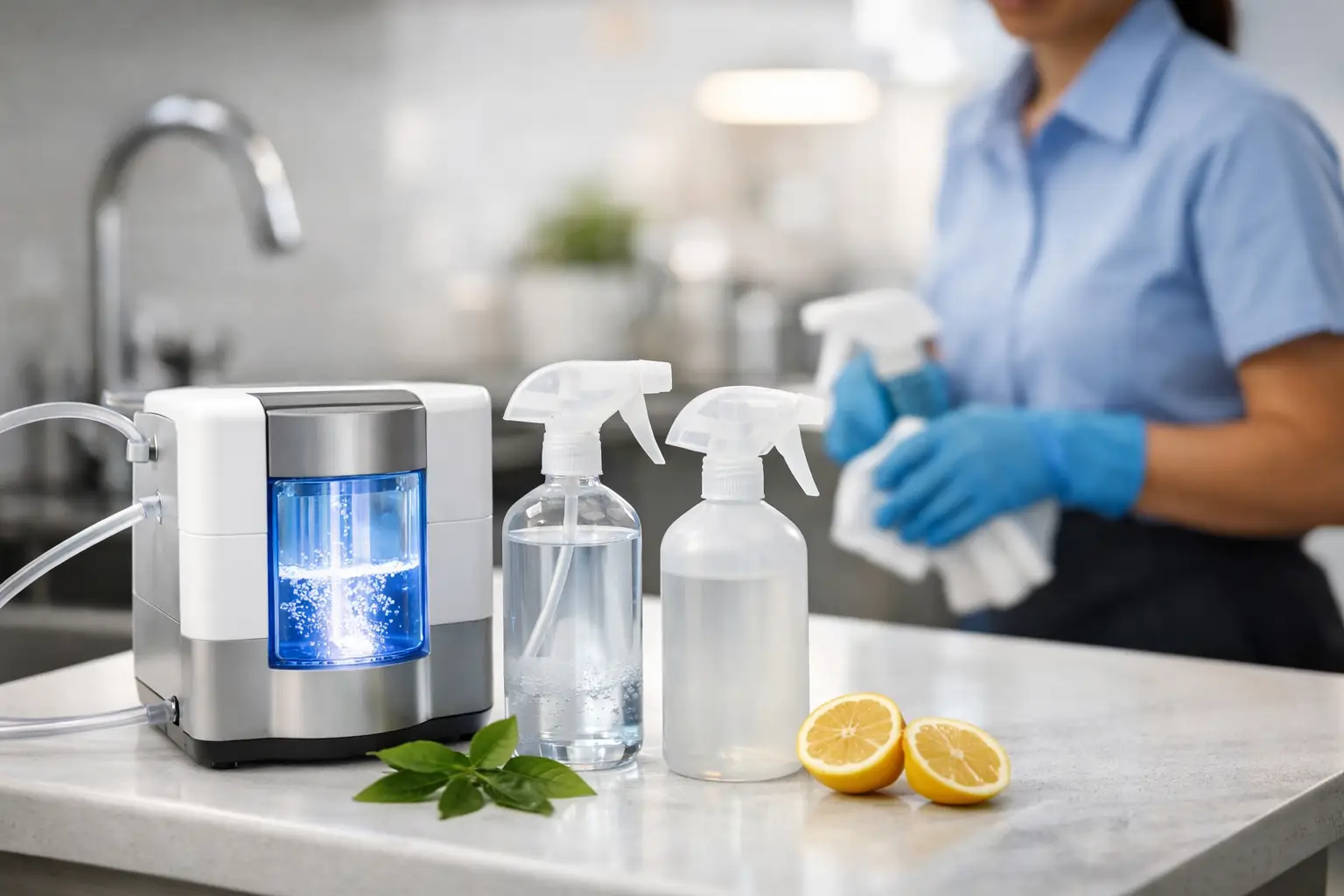
A supply closet full of harsh chemicals, empty spray bottles, and backordered cases is not a sanitation strategy. On-site HOCl generation gives homes, facilities, and service businesses a different option: make a fresh cleaning and odor-control solution from simple inputs, right where the work happens.
For organizations that clean constantly, the practical value is immediate. Instead of relying on repeated shipments of single-use chemical products, operators can create the volume they need for daily surfaces, shared spaces, odor-prone areas, and routine cleaning tasks. The result is a safer, more dependable approach built around water, salt, and a small amount of organic vinegar.
What Is On-Site HOCl Generation?
Hypochlorous acid, or HOCl, is a solution associated with the body’s natural immune response. When produced correctly for cleaning applications, it offers powerful sanitation and deodorizing support without the fumes, harsh residues, or complicated handling practices associated with many conventional cleaners.
On-site generation equipment uses controlled electrochemical processes to convert water, salt, and a small amount of organic vinegar into pH-neutral HOCl solution. The point is not to make chemistry more complicated. It is to make daily cleaning more practical. A team can generate solution in its own facility, fill bottles or applicators, and put that solution to work without waiting for a delivery truck.
That distinction matters when cleaning needs change from one shift to the next. A medical office may need fresh solution for exam rooms and waiting areas. A school may need it for classrooms, restrooms, and high-touch common areas. A grower may need reliable odor control and cleaning support across workspaces. The generator becomes part of the operation rather than another product to reorder.
Why Facilities Are Moving Away From Chemical Dependence
Traditional chemical programs often create costs that do not show up on a single invoice. There is the product cost, of course, but also freight, storage, employee training, container disposal, emergency replacement orders, and the risk of running out at the wrong time.
On-site HOCl generation changes that equation. The core inputs are inexpensive and readily available, allowing operators to make solution for pennies per batch. For high-use environments, that can reduce the recurring cost pressure of packaged cleaning products while providing more control over inventory.
There is also a people-first reason to reconsider harsh chemistry. Strong fragrances, aggressive solvents, and irritating fumes can make routine cleaning unpleasant for employees, guests, patients, students, and families. A pH-neutral HOCl solution supports a more comfortable cleaning experience while still addressing the real-world needs of sanitation and odor control.
This does not mean every cleaning product can be replaced in every setting. Heavy grease, mineral buildup, and specialty surface requirements may call for other products or methods. On-site generation works best as the foundation for frequent, broad-use cleaning and deodorizing, with specialized tools reserved for specialized problems.
The Right Concentration Depends on the Job
Not all cleaning tasks require the same solution strength. The ability to generate different concentrations is one reason on-site systems make sense for both homes and commercial operations.
Microbe Ninja NinjaGen systems produce pH-neutral HOCl solutions at 200, 500, and 1,000 ppm. Lower concentrations can support everyday cleaning and freshening applications, while higher concentrations may be selected for more demanding sanitation and odor-control routines. The correct choice depends on the surface, the environment, the application method, and the operating procedures already in place.
A facility manager should not think only in terms of strength. Volume and workflow matter just as much. If a team needs dozens of spray bottles ready before the morning shift, a compact countertop unit may not be the right fit. If a small business needs a dependable supply for daily service, a right-sized generator can simplify the process without overbuilding the system.
From Home Use to Commercial Scale
For households and small businesses, compact generation equipment can make fresh HOCl solution available without filling cabinets with separate cleaners. That can be especially useful for kitchens, bathrooms, pet areas, trash bins, frequently touched surfaces, and recurring odor concerns.
Larger facilities need a different capacity conversation. Commercial systems such as the NinjaGen 360, 144, and 1440 are designed for operations that require greater output and more organized dispensing. Hotels, schools, restaurants, medical offices, retail operations, farms, and growing facilities can integrate generation into existing janitorial routines instead of asking staff to manage a patchwork of chemical bottles.
The right system is the one that matches actual demand. Buying too small can create bottlenecks. Buying too large can tie up budget and floor space unnecessarily. Estimate the number of gallons or bottles used per day, identify peak-use periods, and consider whether teams need centralized filling or solution delivered to multiple work areas.
Better Dispensing Makes Better Cleaning Habits
Making solution on site is only half the system. Employees also need a simple way to apply it consistently. Clearly labeled bottles, compatible sprayers, refill stations, and practical applicators can determine whether a sanitation program is followed or forgotten.
A strong rollout starts with the work itself. Map the areas that need regular attention, decide who refills containers, set a schedule for making fresh batches, and give staff clear instructions for intended uses. If a team has to guess which bottle is appropriate or where to find it, the program will lose momentum.
Freshness also deserves attention. Generated HOCl should be produced, stored, and used according to the equipment provider’s directions. Light exposure, heat, contamination, and long storage periods can affect solution quality. A sensible routine of making what you need and rotating it promptly supports consistent results while limiting waste.
A More Resilient Model for Cleaning Operations
Supply chain disruptions revealed a basic weakness in many cleaning programs: when the product is not delivered, the process stops. On-site generation gives organizations more independence from that cycle. Water, salt, and a small amount of organic vinegar occupy far less storage space than stacks of ready-to-use containers, and they are less vulnerable to the same purchasing volatility.
For service businesses, this capability can also become a meaningful differentiator. A cleaning or deodorizing provider that can create solution on demand may offer clients a more sustainable, cost-conscious alternative to conventional chemical-heavy programs. The value is not just the solution itself. It is the ability to deliver a repeatable service without relying on a constant flow of packaged inventory.
Sustainability is practical here, not decorative. Generating solution where it will be used can reduce shipping weight, disposable packaging, storage demands, and chemical waste. Those gains matter to organizations with environmental goals, but they also matter to operators who simply want a cleaner, leaner supply room.
Questions to Ask Before Choosing a Generator
Before selecting equipment, start with usage rather than features. How much cleaning and odor-control solution does the operation use in a day or week? Which areas consume the most? Does the team need spray bottles, larger containers, or dedicated applicators? Who will be responsible for batch preparation, equipment upkeep, and quality checks?
It is also wise to review surface compatibility and your facility’s internal protocols. HOCl is a versatile option, but no single solution should be treated as a substitute for thoughtful cleaning procedures, manufacturer guidance, or any applicable local requirements. High-risk environments may have additional policies governing products, dwell times, documentation, and staff training.
The most successful installations are not necessarily the biggest. They are the ones that fit naturally into the daily routine, give people an easier product to use, and reduce the chances of being caught without the supplies needed to keep a space clean and welcoming.
A better cleaning program starts when the solution is available at the moment it is needed. On-site HOCl generation puts that control back in the hands of the people responsible for the space.
Comments are closed