

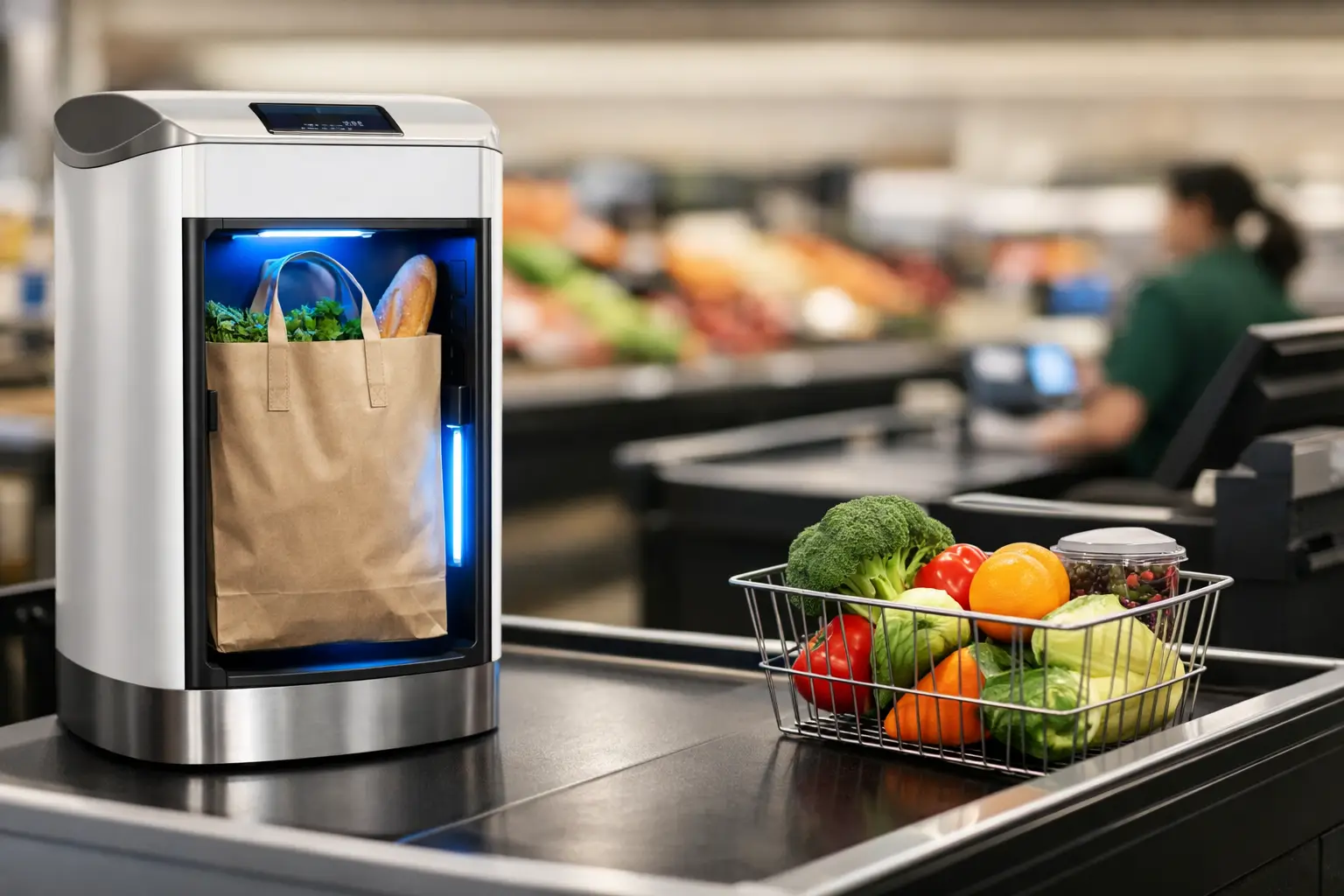
A checkout lane moves fast until a customer hands over a reusable bag that has been through a car trunk, a kitchen floor, and several shopping trips. A grocery bag sanitizer dispenser gives stores and shoppers a practical way to add a quick sanitation step without slowing the entire transaction or relying on harsh chemical products.
The right approach is not about soaking every bag or creating another task employees cannot sustain. It is about placing an easy-to-use applicator where it fits the workflow, supplying a suitable sanitation solution, and setting clear expectations for staff and customers.
What a Grocery Bag Sanitizer Dispenser Should Do
A grocery bag sanitizer dispenser is an application station that delivers a controlled mist or spray to reusable grocery bags before or after bagging. In a retail environment, it can support cleaner bag handling at checkout, customer service counters, curbside pickup areas, and store entrances.
For most operations, the dispenser itself matters less than the complete system behind it. The applicator needs to produce consistent coverage without excessive runoff. The solution needs to be appropriate for the intended use, easy to replenish, and practical for employees to handle throughout a shift. Just as important, the station must be simple enough that people will actually use it.
Hypochlorous acid, commonly called HOCl, is a strong fit for this kind of daily sanitation routine when produced and applied correctly. HOCl is made from water, salt, and electricity, and a pH-neutral formulation can provide a powerful cleaning and odor-control option without the heavy fumes and residue associated with many conventional chemicals.
Why Bag Sanitation Belongs in the Checkout Conversation
Reusable bags are useful, economical, and increasingly common. They also travel between environments that a store cannot control. A bag may carry crumbs, spills, moisture, odors, or general grime from prior trips. That does not mean every bag requires an elaborate treatment process, but it does make a simple, visible sanitation option worthwhile.
For grocery stores, the value is operational as well as customer-facing. A well-placed station demonstrates that the business is thinking about high-touch routines beyond carts and counters. It can also give employees a consistent response when customers ask how reusable bags are handled.
The same logic applies to food service, farmers markets, retail pickup counters, and delivery staging areas. Wherever bags repeatedly move from public spaces into a product-handling workflow, a targeted application point can help create a more controlled process.
There is a trade-off. Stores should not present a dispenser as a substitute for keeping bags clean, training employees, or maintaining standard checkout cleaning procedures. It is one useful layer in a broader sanitation program. It also should not become an excuse to apply solution directly to food, packaging interiors, or delicate materials without confirming that use is appropriate.
Choosing the Right Dispenser Setup
The best setup depends on traffic, bag volume, and who will operate it. A small independent market may only need a compact bottle-based station near the entrance or service desk. A busy supermarket may benefit from a mounted applicator at each bagging zone, supported by an on-site generation system that keeps refills available.
Look for four practical characteristics:
- Controlled application: A fine, even mist helps avoid drips, puddles, and wasted solution.
- Fast reset time: The station should be ready for the next customer in seconds, not require a complicated refill or adjustment.
- Durable placement: It needs a stable location away from food exposure areas and traffic patterns where it could be knocked over.
- Clear instructions: Simple signage should explain when and how to use the station, including any required contact time and drying guidance.
Placement matters as much as equipment choice. At an entrance, the station works best as a customer self-service option before shopping. At checkout, it may be employee-operated, depending on store policy and labor capacity. In pickup areas, it can support the handling of customer-provided totes before an order is loaded.
A spray station is usually more practical than a touch-dependent dispenser in a high-traffic area. Employees can apply solution quickly to exterior bag surfaces, then allow the bag to air dry as appropriate. The goal is purposeful coverage, not a visibly wet bag.
On-Site HOCl Keeps the Program Practical
A bag sanitation routine can fail when the required solution is expensive, difficult to source, or constantly out of stock. That is where on-site HOCl generation changes the economics. Instead of relying on recurring shipments of conventional cleaners, a business can create fresh solution using water, salt, and a small amount of organic vinegar.
Microbe Ninja NinjaGen systems produce pH-neutral HOCl solutions at 200, 500, and 1,000 ppm, allowing operators to match the solution concentration and output capacity to their actual cleaning, deodorizing, and sanitation workflow. For a small market or single checkout area, a compact generator can support regular refill needs. Larger operations can evaluate commercial systems such as the NinjaGen 360, 144, and 1440 for higher-volume use across the facility.
This approach offers more than lower per-batch cost. It reduces dependence on a supply chain that can be unpredictable during busy seasons or disruptions. It also gives teams a single, consistent solution platform for related tasks such as carts, checkout surfaces, restroom odors, bins, and back-of-house cleaning, subject to the operation’s procedures and use requirements.
Build a Routine Employees Can Maintain
A dispenser only works when the routine is clear. Assign responsibility for checking solution level, applicator performance, and station cleanliness at the start of each shift. Staff should know where the solution is intended to be applied, how much to use, and when a bag should be set aside because it is visibly soiled or damaged.
Training should also cover boundaries. Do not spray food directly. Avoid creating overspray near exposed foods, open preparation surfaces, electronics, or materials that may be sensitive to moisture. Follow the solution’s directions, the equipment manufacturer’s instructions, and the store’s food-safety plan.
For customer-facing stations, keep the message simple. A short instruction such as “Mist exterior bag surfaces as needed and allow to air dry” is easier to follow than a dense policy notice. If staff operate the station, a brief script can prevent confusion: “We can apply a light sanitation mist to the outside of your reusable bag before bagging.”
Measure whether the process is working in real conditions. Are employees using it during peak hours? Is the nozzle clogging? Are customers receptive? Is overspray appearing on the counter? A successful program is one that solves these small operational problems early instead of adding a neglected dispenser to the checkout lane.
A Smarter Standard for Reusable Bags
Reusable bags are not going away, and stores do not need a complicated chemical program to handle them responsibly. A thoughtfully placed grocery bag sanitizer dispenser, supplied with on-demand HOCl solution, can make bag sanitation faster, more affordable, and easier to maintain day after day.
Start with the workflow your team already has. When the station is quick to use, the solution is readily available, and the instructions are clear, cleaner bag handling becomes a practical habit rather than another promise posted at the front door.
Comments are closed