

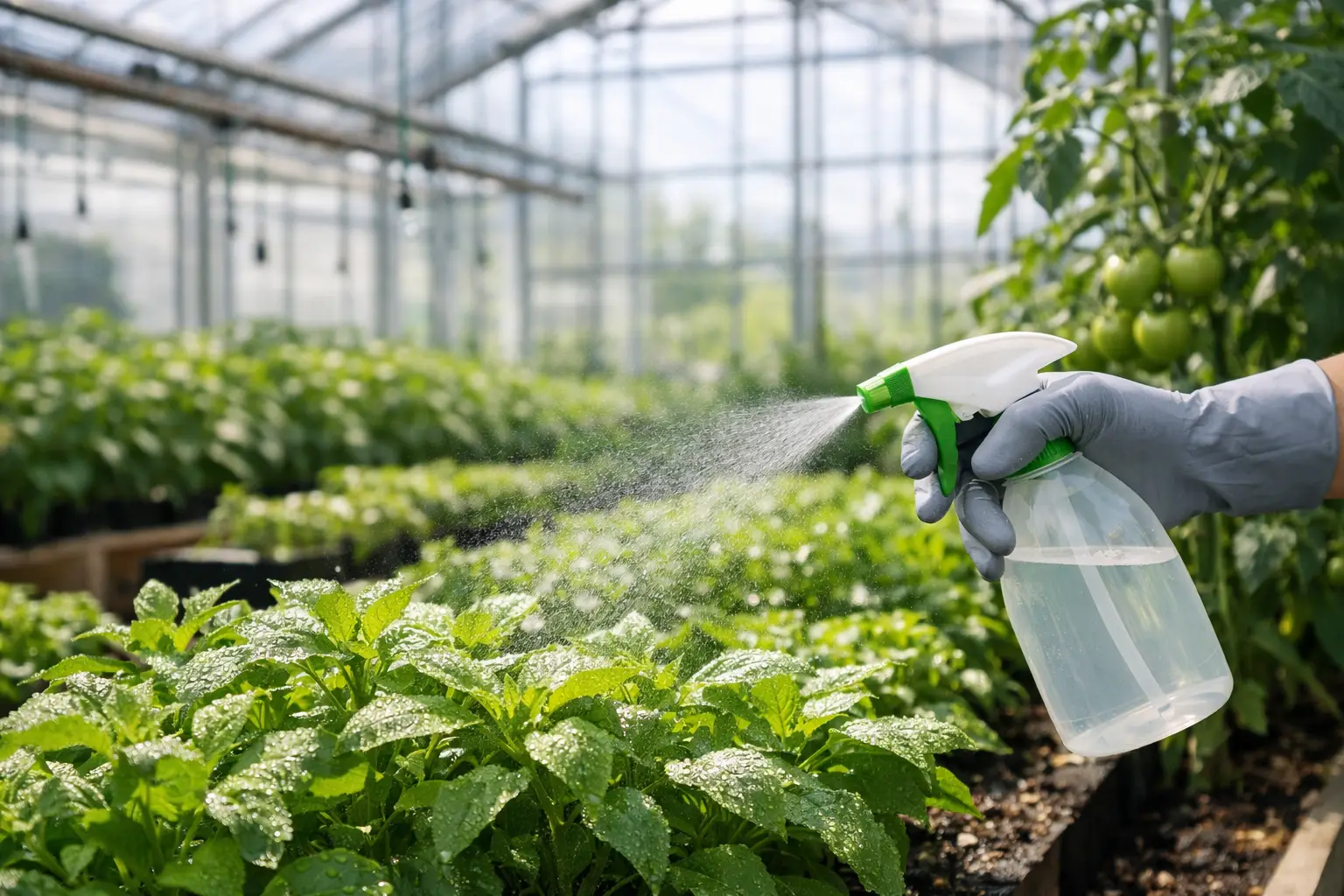
A greenhouse can look spotless and still carry the conditions that invite trouble: algae on walkways, biofilm inside irrigation components, residue on propagation trays, and humid corners that never quite dry. Hypochlorous acid for greenhouse plants gives growers a practical way to build cleaner routines without filling the facility with harsh chemical odors or relying on a constant flow of packaged cleaners.
HOCl is not a substitute for good airflow, drainage, scouting, or crop-specific integrated pest management. It is a sanitation tool. Used with a disciplined cleaning process, it can help greenhouse teams reduce the buildup that makes a growing environment harder to manage.
Why greenhouse sanitation needs a different approach
Greenhouse operations are demanding on cleaning products. Surfaces are frequently wet, workers move between zones, organic debris accumulates quickly, and irrigation systems create plenty of places for residue to collect. A product that works well on a hard floor may not be appropriate for direct contact with sensitive foliage, young cuttings, blooms, or beneficial organisms.
That is why the application matters as much as the solution. In most facilities, the highest-value use of HOCl begins with the non-crop environment: benches between production cycles, trays, carts, tools, floors, drains, mixing areas, door handles, and other high-touch or high-residue surfaces. These are the places where a consistent sanitation routine can save labor later.
Hypochlorous acid is a chlorine-based compound produced in a form that can be used at near-neutral pH. It is associated with a lower-odor, less harsh cleaning experience than many conventional chlorine products. For greenhouse teams, that can mean a more workable option for frequent use around the operation, provided it is mixed, stored, and applied correctly.
Where hypochlorous acid for greenhouse plants fits best
The phrase “for greenhouse plants” can suggest spraying every plant in the house. That is not the right starting point. Start by separating crop-contact uses from facility sanitation uses, then build a protocol around the risk, the crop, and the surface.
Between-crop resets
When a bay is emptied, there is a narrow window to remove plant debris, wash away soil and organic matter, and treat the cleaned surfaces before the next crop arrives. This is one of the most useful times to deploy HOCl. Benches, propagation tables, carts, pots, trays, walls, and workstations can be addressed methodically without the risk of wetting a standing crop.
Cleaning comes first. Organic material can consume available HOCl, so spraying a dirty bench without first removing media, leaves, algae, and residue wastes solution and effort. Sweep or rinse as appropriate, physically clean the surface, then apply the solution according to the established dwell time and operating procedure.
Propagation rooms and tool stations
Propagation is where small sanitation gaps can become expensive. Workers handle cuttings, trays, labels, blades, and benches repeatedly throughout the day. A ready supply of properly prepared HOCl can make it easier to maintain clean tool stations and work surfaces between tasks.
For cutting tools or equipment that contacts plants, use a crop-specific protocol and follow all applicable directions for the equipment and material involved. Do not assume that a solution suitable for a bench is automatically suitable for every tool, cultivar, or propagation practice.
Floors, drains, and odor-prone areas
Standing water and decaying plant material can turn floors and drains into recurring cleaning problems. HOCl can support routine cleaning and deodorizing in these areas, especially when paired with better drainage, algae control, and debris removal. It will not fix a broken drain or chronic overwatering, but it can make routine maintenance simpler and more consistent.
Choosing concentration without guessing
Concentration is commonly measured in parts per million, or ppm. More is not always better. The right concentration depends on the use case, the amount of organic load, contact time, surface type, and whether there is any chance of crop contact.
Microbe Ninja NinjaGen systems can produce pH-neutral HOCl solutions at 200, 500, and 1,000 ppm using water, salt, and a small amount of organic vinegar. That flexibility is valuable in a greenhouse because one operation may need a lower-strength routine cleaner for frequent tasks and a higher-strength solution for tougher facility cleaning jobs.
The key is to establish written procedures rather than relying on memory. Identify which concentration is used for each area, how it is labeled, how long it remains on a surface, and when a rinse is required. Train the team to use the same method every time. Consistency is where sanitation programs deliver their real value.
For direct application near plants, conduct small-scale trials first. Test a limited group of representative plants, including the most sensitive cultivar and growth stage, before expanding use. Watch for leaf spotting, edge burn, changes in color, slowed growth, or effects on flowers. Conditions such as temperature, light intensity, water quality, spray volume, and plant stress can change the outcome.
Protect the crop and the people working around it
A safer cleaning profile does not remove the need for sound operating practices. Greenhouse teams should use appropriate personal protective equipment for their process, prevent accidental mixing with other products, and keep solutions clearly labeled. Never combine HOCl with acids, ammonia-based products, or other cleaners unless the manufacturer specifically directs it.
Avoid treating stressed plants as a test group. Plants already dealing with heat, transplant shock, nutrient imbalance, or water stress are more likely to react poorly to any foliar application. Avoid spraying during the hottest, brightest period of the day, and do not apply a new protocol across valuable inventory without a trial.
Beneficial insects and biological controls deserve the same caution. A sanitation product applied directly in their release zones may interfere with the program you have paid to establish. Coordinate sanitation timing with your integrated pest management plan and keep applications targeted to the intended surface or area.
On-site generation changes the logistics
Many greenhouse managers know the frustration of finding a product that works for the operation, then facing price increases, backorders, storage limits, or too many single-use containers. On-site HOCl generation changes that equation. Instead of depending entirely on delivered chemicals, a facility can produce solution as needed from simple inputs.
That approach can help standardize daily sanitation across a large operation. A commercial system can supply dedicated applicators for production zones, receiving areas, break rooms, restrooms, and maintenance shops while keeping the product inventory simple. It also reduces the need to transport and store large volumes of conventional cleaners.
Freshness still matters. HOCl solutions can lose strength over time, particularly when exposed to heat, light, contamination, or improper storage. Use opaque, compatible containers, keep them closed when not in use, and follow the generator manufacturer’s guidance for testing and shelf life. A solution with an unknown ppm is not a controlled sanitation tool.
Build the routine around the real workflow
The strongest greenhouse sanitation plan is not the one with the most products. It is the one workers can perform correctly on a busy Tuesday when shipments arrive, propagation is underway, and irrigation needs attention.
Assign sanitation tasks to the natural rhythm of the facility. Clean tools and workstations between propagation batches. Address floors and drains on a set schedule. Reset benches and carts between crop cycles. Keep a defined process for spills, algae-prone zones, and high-traffic entrances. Record what was done, what concentration was used, and any crop observations from trials.
If a routine feels too complicated, it will be skipped. If applicators are hard to refill or solution is stored far from the work area, workers will reach for whatever is closest. Placing generation, dispensing, and labeled storage where the work actually happens can turn sanitation from an occasional project into a dependable operating habit.
A clean greenhouse is not created by one spray application. It is built through repeatable choices: remove debris, clean first, apply the right solution to the right surface, protect sensitive plants, and keep the process easy enough to follow every day.
Comments are closed