

A cleaning closet full of heavy jugs is not just a storage issue. It is a recurring purchasing decision, a handling concern, and a point of failure when deliveries run late. In the conversation around onsite generation versus bulk delivery, the right choice comes down to more than price per gallon. It affects how reliably your team can clean, manage odors, maintain sanitation routines, and reduce dependence on harsh conventional chemicals.
For many homes and facilities, ready-to-use products remain practical. But when usage is frequent, volumes are high, or supply certainty matters, producing hypochlorous acid (HOCl) where it will be used can change the operating equation.
What Changes With Onsite Generation Versus Bulk Delivery?
Bulk delivery means purchasing prepared cleaning or sanitation solutions in bottles, jugs, drums, or larger containers. The supplier handles production and shipping, and the customer stores the finished product until it is needed. It is familiar, straightforward, and often appropriate for low-volume or occasional use.
Onsite generation takes a different approach. A generator uses water, salt, and a small amount of organic vinegar to produce pH-neutral HOCl at the point of use. Rather than repeatedly ordering and warehousing finished chemistry, a facility maintains a small set of input materials and makes solution in batches that fit its routine.
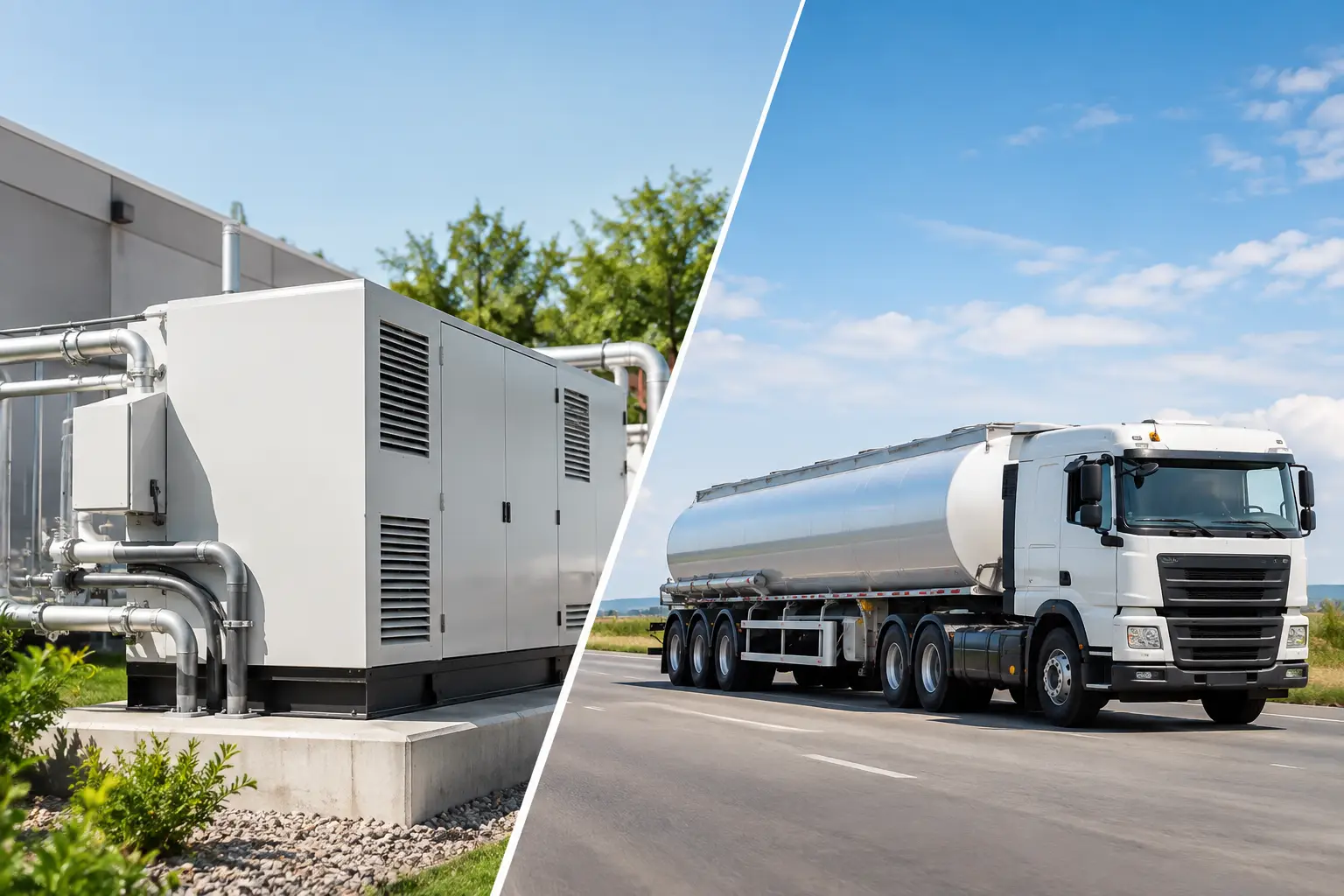
That distinction has practical consequences. Bulk delivery moves water and packaging through the supply chain before a product ever reaches your building. Onsite generation creates the solution inside the building, closer to the moment it is needed.
Cost Is More Than the Price on the Invoice
A case price can make bulk products look easy to compare. Yet the delivered cost of a sanitation program includes much more than the number printed on a purchase order. Freight, storage space, packaging disposal, emergency orders, inventory time, and product loss all add to the real cost.
Ready-to-use products also make an organization pay to transport mostly liquid. For a high-use environment such as a school, hotel, clinic, food-service operation, greenhouse, or cleaning service, those recurring shipments can become a meaningful operating expense.
With an onsite HOCl system, the initial equipment investment is the main economic consideration. After that, the inputs are simple and low-cost. Microbe Ninja NinjaGen systems produce 200, 500, and 1,000 ppm solutions, allowing operators to prepare the concentration that fits their cleaning, deodorizing, and sanitation process. For organizations using solution every day, the cost per batch can be pennies rather than the repeated cost of packaged chemistry.
That does not mean onsite generation always has the lowest cost on day one. A homeowner who needs only a few bottles per year may reasonably prefer ready-to-use products. The advantage grows when use is frequent, volume is consistent, and the organization can put the equipment to work regularly.
Storage, Safety, and Daily Handling
Bulk chemical programs require a place to store finished products safely. That can mean dedicated closets, shelving, secondary containment practices, inventory rotation, and staff training on labels and handling. In a tight facility, cases and drums compete with supplies that are equally essential.
Onsite generation can sharply reduce the number of finished-product containers on hand. Instead of managing a large inventory of prepackaged cleaners, teams can generate solution as needed and dispense it into clearly identified applicators and containers. Less stored finished chemistry can simplify a cleaning area and reduce clutter.
The safety case also matters. pH-neutral HOCl is valued because it offers a powerful sanitation and odor-control option without the harsh fumes or residue associated with many conventional cleaners. That makes it useful in spaces where people, pets, food-contact workflows, sensitive surfaces, and day-to-day operations all need consideration.
Still, “safer” does not mean careless. Every facility needs written procedures for solution preparation, container labeling, appropriate application, storage, and staff training. Teams should follow equipment instructions, maintain applicators, and use the concentration appropriate to the task. Good systems make sanitation easier to manage, but they do not replace sound operating practices.
Supply Reliability Is a Business Issue
When a delivery is delayed, a bulk-dependent facility has limited choices: stretch what remains, substitute a product, place an expensive rush order, or interrupt normal routines. That is a weak position for any operation responsible for clean, comfortable spaces.
Onsite generation creates a useful layer of independence. Water, salt, and organic vinegar take up far less space than repeated shipments of finished solution. With a properly maintained generator and a basic supply of inputs, a facility can continue making HOCl without waiting for a truck.
This is especially valuable for multi-shift operations, seasonal businesses, agricultural settings, and service companies that cannot predict every client need. A cleaning entrepreneur, for example, can produce fresh solution for scheduled accounts instead of tying up cash in cases of packaged products. A facility manager can scale production during a busy period without rebuilding a purchasing plan from scratch.
Independence is not the same as eliminating planning. Generators require preventive maintenance, reliable water access, trained operators, and enough containers to support the workflow. The difference is that those requirements are within the facility’s control instead of being tied entirely to supplier inventory and transportation schedules.
Freshness and Concentration Need a Process
One of the strongest reasons to generate HOCl onsite is the ability to make solution closer to use. Like many active cleaning solutions, HOCl should be managed with attention to concentration, storage conditions, and age. Heat, light, contamination, and time can affect solution performance.
Bulk products may be convenient, but they can spend time in production, transit, warehouse storage, and a facility closet before they are applied. That does not automatically make them ineffective, but it makes inventory discipline essential. Teams need to rotate stock, watch dates, and avoid treating every bottle as interchangeable.
Onsite generation gives operators more control over that timeline. A facility can create a batch, verify it according to its procedures, label it with the production date and concentration, and use it within the recommended window. This approach supports consistency, especially when several departments or mobile crews rely on the same sanitation standard.
Water quality also deserves attention. Facilities should use the input water and ingredients specified for their equipment and follow the manufacturer’s instructions. A generator is a production tool, not a magic faucet. Consistent inputs and simple quality checks help protect consistent results.
Which Option Fits Your Operation?
Bulk delivery is often the practical choice when demand is light, storage is easy, and a team wants a ready-to-use product without adding a production step. It can also serve as a useful backup for remote jobs or short-term needs.
Onsite generation becomes more compelling when an organization uses solution daily, manages multiple rooms or sites, faces storage constraints, or wants to reduce recurring purchases of packaged chemicals. It is well suited to medical offices, schools, hotels, restaurants, retail spaces, offices, farms, greenhouses, and professional cleaning operations where cleaning and odor control are ongoing responsibilities.
System size should follow real demand. Compact generators can support homes and small businesses. Larger systems, including 360, 144, and 1440 configurations, are designed for commercial-scale production. The goal is not to buy the biggest machine. It is to match output capacity, container needs, staffing, and expected use so the system becomes part of the routine rather than another underused asset.
Make the Decision Around Control
The most useful question is not, “Which product costs less per bottle?” Ask instead: How much control does our operation need over cost, availability, storage, and daily sanitation?
Bulk delivery buys convenience at the point of purchase. Onsite generation builds capability at the point of use. For organizations that want powerful, safe, sustainable, and cost-effective HOCl available on demand, that capability can turn a recurring supply problem into a routine they own.
Comments are closed