

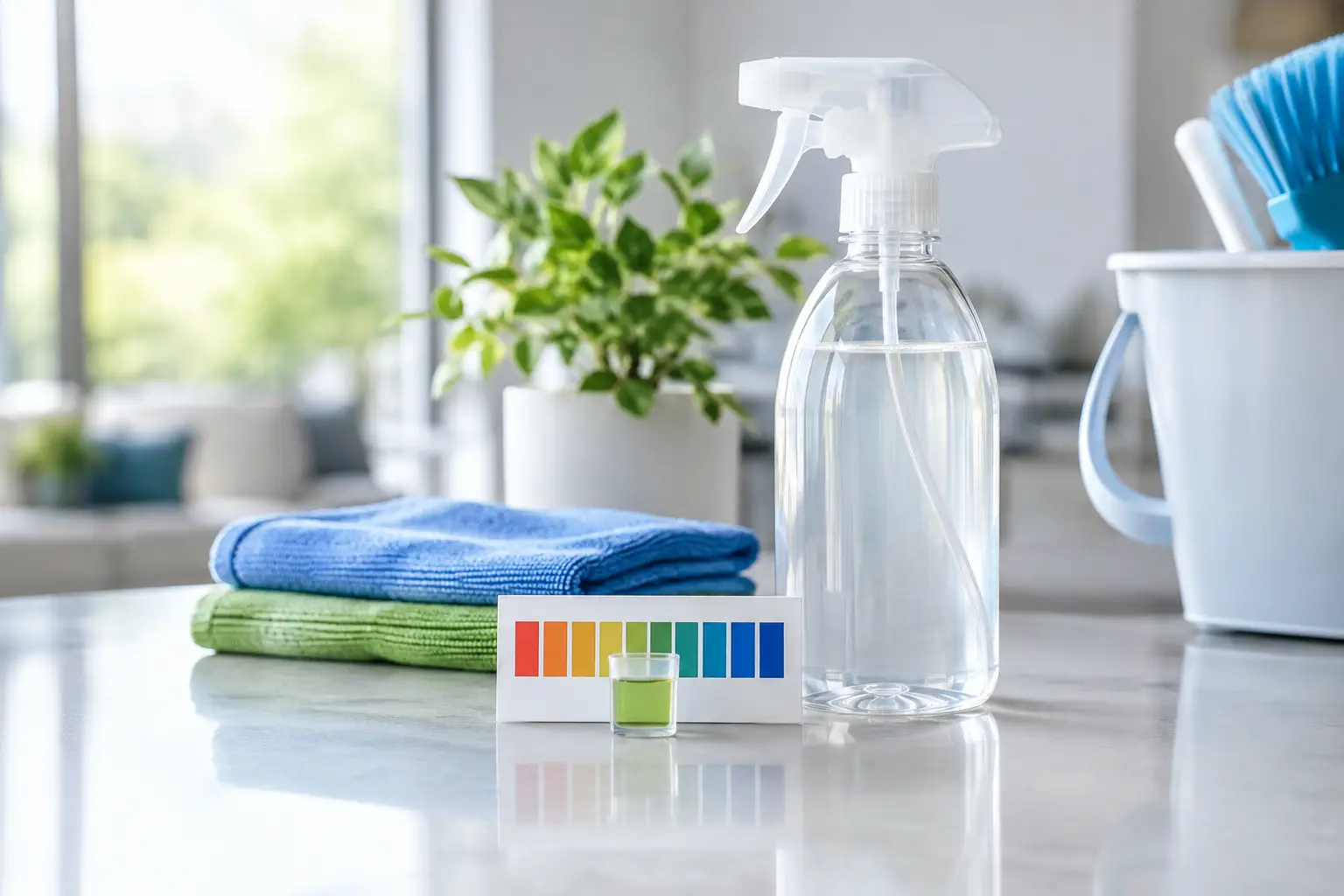
A marble countertop can lose its finish long before anyone notices. A stainless-steel fixture can become streaky. A frequently cleaned floor can still carry a dull film from product residue. These are often signs that the cleaning chemistry does not match the surface or the job. This pH neutral cleaning guide explains where neutral solutions make sense, where they do not, and how to build a safer, more practical cleaning routine around them.
For homes, schools, restaurants, medical offices, and large facilities, the goal is not to use the strongest product possible. It is to remove soil, manage odors, support sanitation needs, and protect the people and surfaces that keep a space running.
What pH Neutral Actually Means
The pH scale measures whether a water-based solution is acidic, neutral, or alkaline. A pH of 7 is neutral. Numbers below 7 are acidic, while numbers above 7 are alkaline. In everyday cleaning, acidic products are often used against mineral buildup, and alkaline products are often used to break down heavy grease and oils.
A pH-neutral cleaner sits close to the middle of that scale. Its value is usually gentler interaction with many common materials, including finished floors, sealed stone, stainless steel, painted surfaces, plastics, and many fabrics. That does not mean every neutral product is identical, or that neutral chemistry automatically removes every type of soil. Formulation, contact time, soil load, and application method still matter.
The practical advantage is consistency. When staff or family members are cleaning high-touch surfaces all day, a solution designed for routine use can reduce the need to rotate through harsh, specialty chemicals for every task.
Why pH Matters for Daily Cleaning
Cleaning products are frequently chosen based on scent, foam, or a label promise. pH is less visible, but it has a direct effect on how a product behaves on surfaces and around people.
Highly acidic cleaners can be useful for stubborn scale, rust staining, and mineral deposits. Used too often or left too long, they may etch natural stone, damage finishes, or corrode sensitive metals. Strong alkaline degreasers have their place in kitchens, maintenance areas, and heavy-duty operations, but they can be hard on skin and may leave residue if not properly removed.
A neutral option is often the better default for routine cleaning because it is less likely to create a new problem while solving the current one. This matters most in facilities with many surface types, limited training time, and constant turnover between shifts.
Neutral Does Not Mean One Product for Every Job
The most effective cleaning programs use the right chemistry for the situation. Grease baked onto a commercial oven may require a purpose-built degreaser. Mineral scale inside a fixture may need an acidic descaling product. A pH-neutral solution is not a substitute for every specialty task.
But those heavy-duty jobs should be the exception, not the daily baseline. For countertops, tables, restroom touchpoints, appliances, toys, entry areas, workstations, and routine odor control, a neutral solution can simplify operations considerably.
Where pH-Neutral Cleaning Fits Best
A pH-neutral approach is especially useful in spaces where frequent cleaning is necessary and surface preservation matters. Think of hotel rooms turned over every day, school desks cleaned between classes, retail counters, exam rooms, shared office equipment, and busy family kitchens.
It is also valuable where people may be more sensitive to harsh fumes or residues. That includes homes with children and pets, senior living communities, health-focused businesses, and enclosed work areas with limited ventilation. A product that is comfortable to use does not eliminate the need to follow label directions, but it can make regular cleaning easier to sustain.
For facility teams, fewer chemistry categories can also mean fewer purchasing headaches, less storage complexity, and simpler staff training. That is a real operational benefit when supply availability and budget pressure are ongoing concerns.
Hypochlorous Acid and pH-Neutral Cleaning
Hypochlorous acid, commonly called HOCl, is a water-based chemistry that can support cleaning, deodorizing, and pathogen-control routines when it is produced and used correctly. It is related to a compound naturally produced by the human immune system, which helps explain why it has drawn attention as a practical alternative to many harsh conventional chemicals.
Its performance depends heavily on concentration, pH, freshness, and application. Not every HOCl solution is the same. A solution intended for light daily cleaning may be different from one prepared for more demanding sanitation applications. The right concentration should match the use case and the manufacturer’s directions.
Microbe Ninja’s NinjaGen systems produce pH-neutral HOCl from water, salt, and a small amount of organic vinegar. Available output concentrations include 200, 500, and 1,000 ppm, giving homeowners and commercial operators the ability to prepare solution on site rather than depend entirely on shipped, prepackaged chemical inventory.
That on-demand model changes the economics of routine cleaning. Instead of purchasing and storing multiple bottles for every room and task, an operation can generate the solution it needs for pennies per batch. For a property manager, restaurant operator, grower, or cleaning-service entrepreneur, that can reduce both recurring costs and supply-chain exposure.
A Practical pH Neutral Cleaning Guide for Daily Use
Start by identifying the surface and the soil. A neutral solution is well suited to daily grime, fingerprints, tracked-in dirt, fresh spills, routine odors, and general upkeep. If a surface has thick grease, hardened residue, or mineral deposits, address that targeted problem first with the appropriate product and process.
Next, remove visible debris before applying a cleaning solution. Wiping away crumbs, dust, hair, and loose soil gives the chemistry a better chance to contact the surface evenly. For larger areas, use clean microfiber tools and change them often. Reusing a heavily soiled cloth across multiple rooms can spread soil instead of removing it.
Apply enough solution to wet the surface without creating unnecessary runoff. Allow the recommended contact time for the intended application, then wipe, air dry, or rinse when the product directions call for it. More product is not always better. Proper coverage and adequate time are usually more important than oversaturation.
Finally, keep tools and workflow organized. Use separate cloths or mop heads for restrooms, food-prep areas, and general spaces. Clean from higher surfaces to lower surfaces, and move from cleaner areas toward dirtier ones. These simple habits often improve outcomes more than adding another chemical to the cart.
Common Mistakes That Undercut Results
The first mistake is assuming “neutral” means “no precautions needed.” Even gentler chemistry should be stored properly, kept out of children’s reach, and used according to product instructions. Never mix cleaning products unless the manufacturer specifically says it is safe to do so.
The second is treating odor as a fragrance problem. Heavy fragrance can cover an odor temporarily, but it does not address the material causing it. A better routine focuses on removing the soil source, cleaning the affected surface, and using a deodorizing solution appropriate for the setting.
The third is using one dirty tool all day. Mops, towels, spray bottles, and buckets can become part of the contamination problem when they are not maintained. Build laundering, replacement, and refill procedures into the cleaning schedule.
A final mistake is overlooking water quality and solution management when generating HOCl on site. Follow the equipment instructions for ingredients, output settings, container cleanliness, and storage. Reliable chemistry starts with a reliable process.
How Businesses Can Make the Switch Without Disrupting Operations
A full chemical reset is not necessary on day one. Start with a defined daily-cleaning zone, such as lobby touchpoints, guest rooms, office areas, restroom surfaces, or break rooms. Track product usage, labor time, employee feedback, odor complaints, and surface condition for several weeks.
Then standardize what works. Create simple instructions that tell staff which concentration to use, how to apply it, how long to leave it on the surface, and which tools belong in each area. The best cleaning program is one that employees can follow accurately during a busy shift.
For organizations with multiple locations or large square footage, on-site generation can provide a more dependable supply model. Commercial systems can support high-volume operations while reducing the storage burden associated with purchasing, transporting, and managing many conventional chemical products.
Choose Cleaning Chemistry That Supports the Space
A pH-neutral routine is not about settling for less cleaning power. It is about using practical chemistry more intelligently: strong enough for everyday demands, gentle enough for repeated use, and simple enough to become a habit. When your cleaning program protects surfaces, reduces harsh chemical exposure, and keeps solution available when it is needed, cleaner spaces become easier to maintain day after day.
Comments are closed