

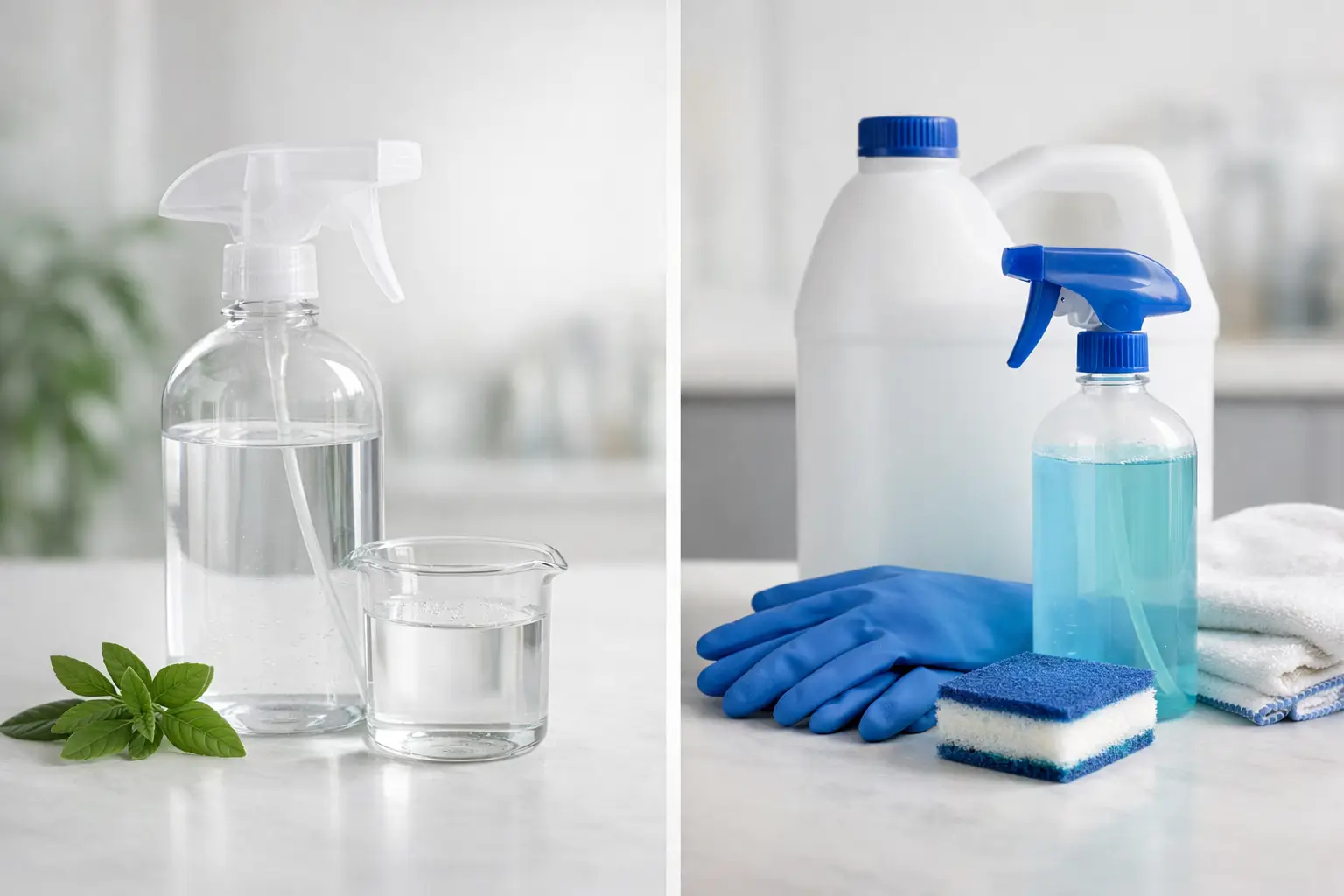
A cleaning cart can carry a hidden operational cost: harsh residues, damaged surfaces, complicated worker training, and an endless cycle of reordering chemical products. The choice between HOCl versus quaternary ammonium cleaners is not just about which bottle works. It affects how safely teams can clean, how consistently they follow procedures, and whether a facility can produce a dependable sanitation solution when supply chains tighten.
Quaternary ammonium compounds, often called quats, have been familiar tools in commercial cleaning for decades. Hypochlorous acid, or HOCl, offers a newer operational model: a powerful sanitation solution that can be generated on site from water, salt, and a small amount of organic vinegar. Both can have a place in a cleaning program. The better choice depends on the setting, the surfaces involved, the people doing the work, and the need for fresh, affordable product on demand.
HOCl Versus Quaternary Ammonium Cleaners: The Core Difference
Quats are a family of synthetic chemical compounds used in many ready-to-use sprays, wipes, concentrates, and floor-care products. They are designed to stay on a surface for a specified contact period, so workers need to apply them according to the product directions and avoid wiping them away too soon. Depending on the formula, quats may also leave a residue that can build up over repeated use.
HOCl is a molecule also produced by the human immune system as part of its natural response to microbes. For cleaning and sanitation applications, it can be made through a controlled electrochemical process. A properly produced, pH-neutral HOCl solution provides broad sanitation and odor-control capability while remaining gentle enough for many everyday environments.
The practical distinction is significant. Quats generally arrive through conventional chemical supply channels in prepackaged products or concentrates. An on-site HOCl generator gives a home, business, or service provider the ability to make fresh solution as needed. That changes purchasing, storage, waste, and daily workflow.
Safety for People, Pets, and Daily Workflows
Safety is often where the comparison becomes most relevant. Quat products can be effective when used correctly, but they require thoughtful handling. Certain formulas may call for gloves, ventilation, dilution control, or restrictions around food-contact surfaces. Staff must understand the directions, especially where a product needs a follow-up rinse or cannot be mixed with another cleaner.
HOCl offers a different profile for routine sanitation. A pH-neutral solution made at the appropriate concentration can be used for many high-touch and odor-control applications without filling a room with heavy fragrance or chemical fumes. That matters in schools, medical offices, restaurants, hospitality spaces, homes with children and pets, and facilities where workers clean throughout the day.
“Safer” does not mean careless. Any cleaning solution should be stored appropriately, applied as directed, and kept out of reach of children. HOCl quality also matters. Concentration, pH, production method, storage, and age all influence performance. The advantage of on-site generation is that operators can produce the volume and ppm level needed for the job rather than relying on a case of products that may sit in storage for months.
Surface Residue and Compatibility
Quat-based cleaners can be convenient for specific applications, particularly when a facility already has documented procedures built around a particular product. The trade-off is residue. Repeated use on counters, floors, equipment, and high-touch surfaces may create a film over time, especially if the surface is not periodically rinsed or if the product is overapplied.
That residue can affect more than appearance. On floors, it may contribute to dullness or attract soil. On food-preparation surfaces, teams need to know when rinsing is required. In areas with sensitive users, fragrance and chemical residue can become a comfort concern as well as a cleaning concern.
HOCl is valued because it can provide sanitation support without the heavy, sticky feel associated with some conventional cleaners. It is a practical option for hard, nonporous surfaces, touchpoints, restrooms, odor-prone spaces, and many daily cleaning tasks. Still, no product is universal. Always test a small, inconspicuous area first, especially on specialty finishes, untreated wood, natural stone, electronics, or materials with manufacturer-specific care instructions.
Odor Control Is Not the Same as Covering Odor
Many commercial cleaners handle odor by adding fragrance. That can make a space smell clean while leaving the source of the odor unaddressed. In restrooms, trash areas, locker rooms, pet spaces, agricultural operations, and break rooms, this approach often creates a cycle of spray, cover, and repeat.
HOCl is useful because it targets odor-causing organic material rather than simply layering scent over it. For a hotel dealing with room turnover, a restaurant managing back-of-house odors, or a greenhouse controlling persistent smells in work areas, that can reduce the need for separate deodorizing products.
Quats may also be included in deodorizing formulas, but fragrance and additives vary widely by product. When comparing options, look past the label claim of “fresh scent.” Ask whether the product supports odor control at the source, whether it leaves scent behind, and whether that scent fits the environment.
Cost and Supply Dependence
The sticker price of a cleaning bottle does not reveal its full cost. Quat programs can involve concentrates, dispensers, refill cartridges, wipes, shipping, storage space, chemical inventory management, and product disposal. A large facility may use several quat products for different rooms and surfaces, making consistency harder to maintain.
On-site HOCl generation simplifies that equation. Microbe Ninja’s NinjaGen systems use water, salt, and a small amount of organic vinegar to make pH-neutral HOCl at 200, 500, and 1,000 ppm concentrations. The inputs are simple, compact, and available without depending on frequent deliveries of conventional chemical cleaners.
For a small business, that may mean producing solution for pennies per batch instead of constantly restocking spray bottles. For a larger operation, systems such as the NinjaGen 360, 144, and 1440 can support higher-volume workflows while reducing plastic packaging and storage demands. The savings depend on usage volume, current product costs, labor practices, and the equipment selected, but the supply-chain advantage is clear: make what you need when you need it.
Where Quats Still May Fit
A fair comparison is not an argument that every quat product must disappear overnight. Some organizations have established policies, customer requirements, or surface-specific procedures that call for particular chemical products. In those cases, a transition should be planned, not improvised.
Quats may remain appropriate where a product specification requires them or where a facility has a narrow use case supported by its existing program. The key is avoiding duplicate chemistry and unnecessary complexity. If a team is using one product for routine cleaning, another for odor control, another for high-touch surfaces, and another for floors, there may be an opportunity to simplify.
HOCl is especially compelling for organizations that want to reduce harsh chemical exposure, lower recurring supply costs, and create a more flexible daily sanitation routine. It also gives sustainable cleaning service businesses a clear offering: on-demand sanitation and deodorizing without hauling an assortment of conventional chemical products to every job.
Choosing the Right System for Your Environment
Start with the work, not the bottle. A homeowner may need a compact generator for kitchens, bathrooms, pet areas, and everyday touchpoints. A daycare, office, restaurant, or medical practice may need reliable refill stations and standardized spray applicators. A hotel, school district, farm, or food operation may need commercial-scale output that keeps pace with shifts, room turns, or recurring cleaning schedules.
Then evaluate four practical questions:
- Can staff use the solution safely and consistently during a busy shift?
- Does it match the surfaces, odor issues, and sanitation needs in the facility?
- What does the program cost after shipping, storage, packaging, labor, and waste are included?
- Can the operation maintain supply during disruptions or sudden increases in demand?
The strongest sanitation program is one people can actually follow. When the solution is safe to use, easy to replenish, effective for the task, and affordable enough for daily use, better habits become easier to sustain. That is where on-site HOCl generation can move cleaning from a recurring supply problem to a practical part of how a healthier space is run.
Comments are closed