

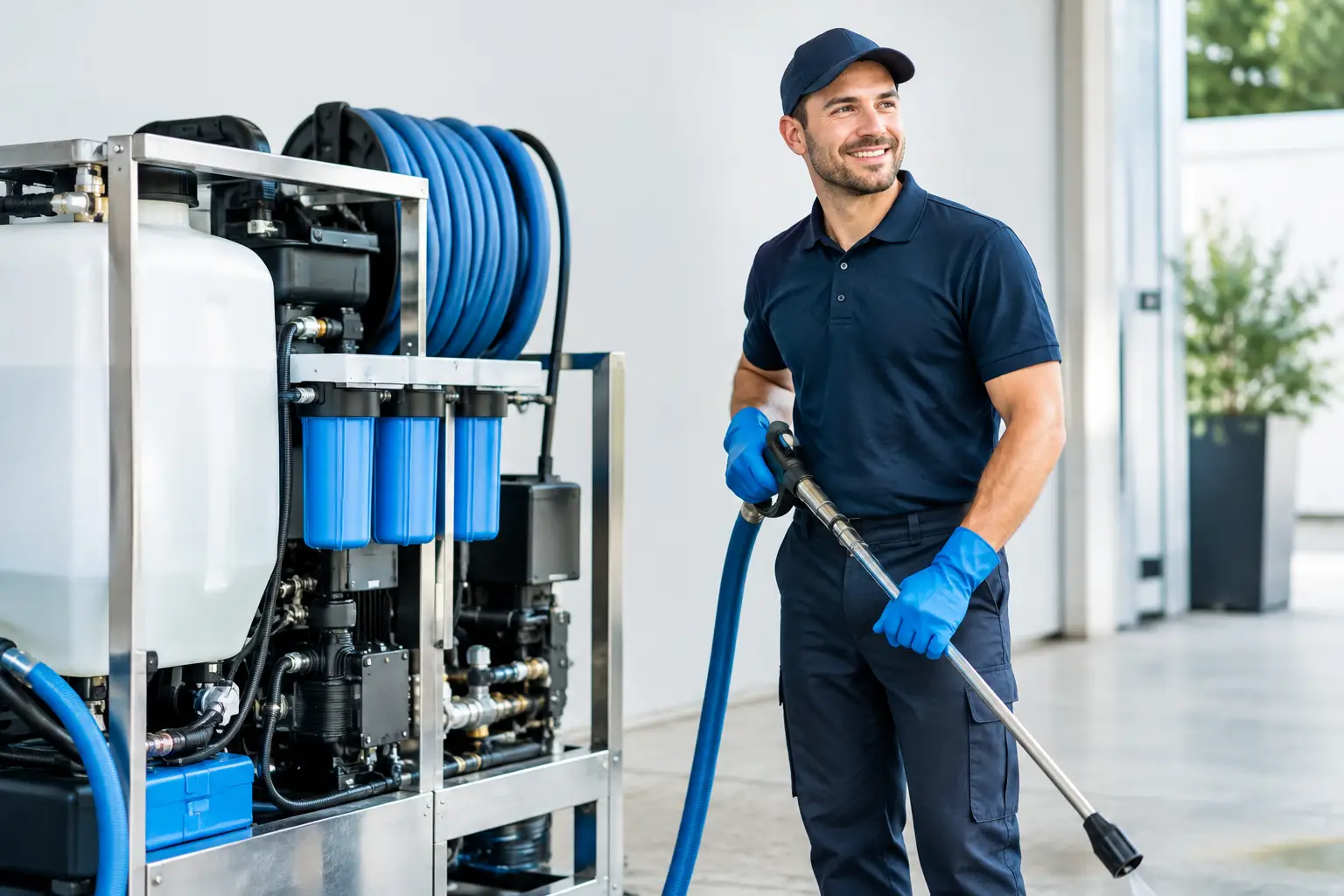
A supply closet full of half-used bottles creates more than clutter. It creates purchasing uncertainty, staff confusion, storage concerns, and a recurring expense that grows with every delivery. The reasons to choose onsite cleaning systems become clear when a facility can make its own cleaning and deodorizing solution where it is needed, using simple inputs instead of depending on a long chain of packaged chemicals.
For homes, small businesses, and large commercial operations, on-site hypochlorous acid (HOCl) generation changes the daily sanitation routine. Water, salt, and a small amount of organic vinegar can be converted into a pH-neutral HOCl solution for cleaning, deodorizing, and pathogen-control applications. That is a practical shift, not a theoretical one: the solution is made on demand, applied where work happens, and replenished without waiting for another chemical shipment.
Why Choose Onsite Cleaning Systems?
The strongest case is not that every operation needs the same equipment. A home with pets has different needs than a hotel laundry room, school campus, greenhouse, or medical office. The advantage is control: choosing an output level, production capacity, and application method that fit the actual work instead of buying another one-size-fits-all bottle.
1. They reduce dependence on chemical deliveries
Conventional cleaning programs are vulnerable to stockouts, price changes, delayed freight, and shifting product availability. When a frequently used product is unavailable, teams may substitute unfamiliar chemicals or stretch remaining inventory longer than they should. Neither approach supports consistent operations.
An onsite system gives a facility a dependable way to produce cleaning and deodorizing solution from basic inputs. Keeping water, salt, and a modest supply of organic vinegar on hand is far simpler than managing a revolving inventory of ready-to-use chemicals. For a restaurant, school, or property management team, that means less time spent chasing purchase orders and more confidence that daily cleaning can continue.
This does not eliminate inventory management altogether. Bottles, sprayers, applicators, and the generator itself still need care. But it replaces repeated bulk-chemical ordering with a far more predictable process.
2. They can lower the real cost of daily sanitation
The price on a cleaning bottle rarely reflects its full cost. Facilities also pay for shipping, storage space, product handling, damaged containers, frequent reorders, and the labor spent sorting through multiple products. High-volume environments feel those hidden costs quickly.
On-site HOCl production can bring the cost per batch down to pennies. The savings are especially meaningful when cleaning and odor-control needs are routine rather than occasional. Instead of paying for water-heavy packaged products to travel across the country, operations create solution at the point of use.
The right financial comparison should include equipment, maintenance, staff training, and expected volume. A compact generator may be a smart choice for a household or small office, while a high-output system makes more sense for a facility that fills multiple containers each day. The goal is not simply to buy the largest unit. It is to match production capacity to demand.
3. They support a safer cleaning routine
Harsh chemical odors, heavy residue, and complicated mixing instructions can make cleaning feel like a hazard-management task. Employees and family members should not need a chemistry degree to maintain clean spaces.
pH-neutral HOCl offers a practical alternative for everyday cleaning and deodorizing needs. It can be used across many common environments without building a routine around aggressive fumes or a cabinet full of incompatible products. That matters in spaces where people live, learn, work, receive care, prepare food, or spend long hours indoors.
Safe use still depends on following equipment instructions, labeling bottles clearly, and training staff on proper application. A simpler chemistry program is not a reason to abandon process. It is a reason to make the process easier to follow consistently.
4. They make fresh solution available when it matters
Ready-to-use products may sit in a warehouse, on a truck, in a storage room, and then on a shelf before they reach the point of use. Onsite generation allows teams to make what they need for the day or shift, rather than relying entirely on prepackaged inventory.
Fresh production is useful for operations with changing demand. A hotel may need more odor control after a busy weekend. A daycare may need to refill applicators throughout the day. A grow operation may need to respond quickly to sanitation needs across propagation areas, tools, and work surfaces.
The trade-off is that someone must own the production routine. Successful programs assign responsibility, establish a refill schedule, and use properly labeled containers. Onsite systems reward good habits with dependable access to solution.
5. They simplify products, training, and application
A crowded chemical room usually signals a complicated workflow. Different products may require different dilution rates, contact instructions, safety gear, storage requirements, and spray equipment. The more decisions a team must make under time pressure, the more likely inconsistency becomes.
An onsite HOCl program can reduce that complexity by creating a consistent solution for routine cleaning and deodorizing tasks. Dispensing applicators further improve the workflow by helping teams apply solution where it is needed, whether that is a restroom, guest room, break room, classroom, reception area, animal-care space, or produce-handling area.
Simplification does not mean every task has identical requirements. Specialty soils, equipment specifications, and industry procedures still matter. But a reliable daily-use system can give staff a clear starting point instead of asking them to navigate an entire shelf of products.
6. They reduce packaging and shipping waste
Conventional chemical programs often involve a repetitive cycle: manufacture plastic containers, fill them, box them, ship them, store them, use them, and discard or recycle them. Multiply that cycle across weekly or monthly orders, and the material footprint becomes difficult to ignore.
Generating solution on site reduces the need to transport large volumes of packaged liquid. Reusable bottles and applicators can stay in service while the generator provides fresh batches as needed. For organizations with sustainability goals, that is a measurable operational improvement, not just a marketing statement.
There is also a practical benefit: less incoming chemical inventory can mean less space devoted to cases, cartons, and overflow storage. In facilities where square footage is valuable, a smaller storage burden is worth considering.
7. They scale from a kitchen counter to a commercial operation
Onsite generation is not limited to one type of user. A homeowner may want a compact system for regular kitchen, bathroom, laundry, and pet-area cleaning. A small business may need consistent refill capability without adding another vendor relationship. A large operation may need enough output to support multiple teams and locations throughout a shift.
That range is why capacity matters. Microbe Ninja offers systems designed around different operating volumes, from compact units to NinjaGen 360, 144, and 1440 commercial-scale systems. Output options at 200, 500, and 1,000 ppm help organizations choose a solution approach aligned with their cleaning, deodorizing, and pathogen-control needs.
For service entrepreneurs, the same model creates a business opportunity. An onsite application business can provide clients with a more sustainable cleaning and deodorizing option while avoiding the recurring logistics of hauling and storing large volumes of conventional chemical products. The strongest operators will still build their service around training, dependable equipment care, and clear customer expectations.
Choosing the Right Onsite System
Start with volume, not assumptions. Estimate how much solution is used during an average day, then account for peak periods, refill locations, and the number of staff members who need access. Consider whether the solution will be applied through spray bottles, larger dispensing systems, or specialized applicators.
Next, look at the environment. A busy hotel, restaurant, healthcare office, school, or agricultural facility may benefit from a higher-output generator and a formal refill process. A home, salon, independent retail store, or small office may value a compact unit that keeps routine cleaning affordable and straightforward.
Finally, make implementation part of the purchase decision. The best system is one your people will use correctly. Clear labels, assigned responsibilities, basic training, and a regular maintenance check turn an onsite generator from a piece of equipment into a dependable part of daily operations.
A cleaner supply chain starts close to the work itself. When your team can make a powerful, safe, sustainable, and cost-effective HOCl solution on demand, cleaning becomes less about waiting for the next shipment and more about maintaining the spaces people count on every day.
Comments are closed